
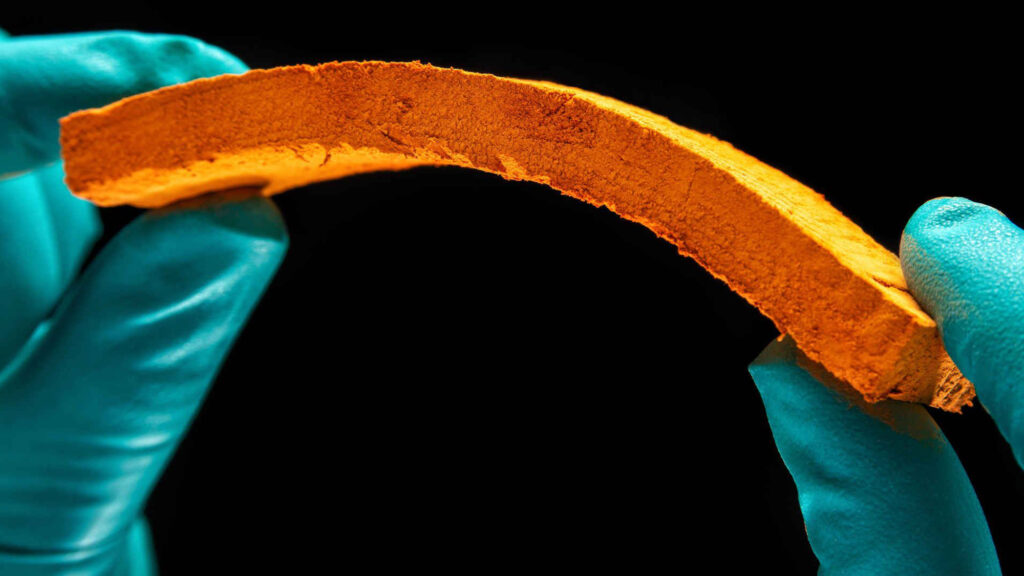
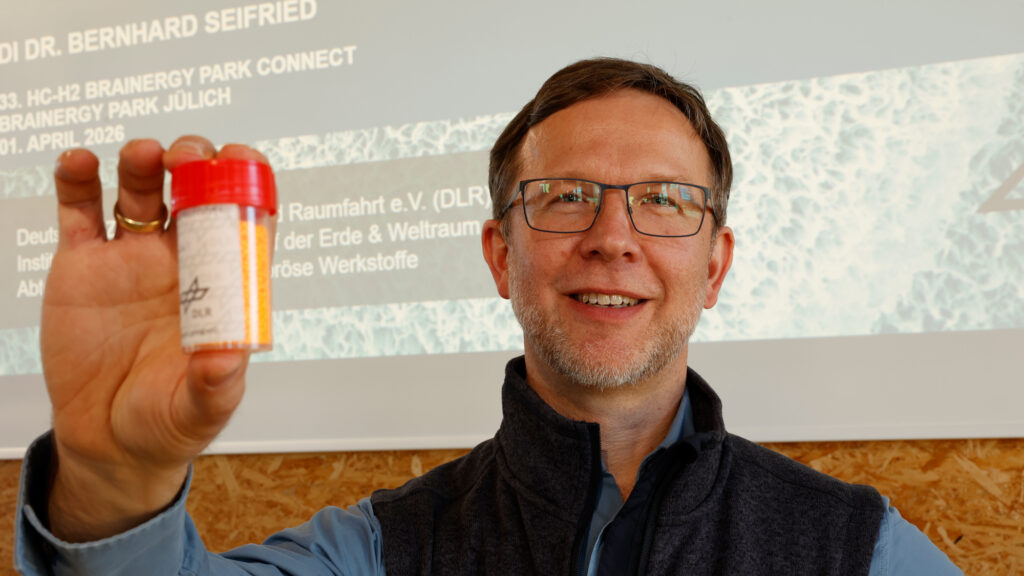
Aerogels are actually quite an aerial act. “They have a low weight and a huge surface area at the same time,” says Dr. Bernhard Seifried from the German Aerospace Center (DLR) at the latest HC-H2 Brainergy Park Connect. The Connect in question is the monthly meeting of park residents. And DLR is one of them. So far with a container facility in the south of the park. And hopefully with more in the future. That’s how Frank Drewes, one of the park’s managing directors, puts it. There are plans for an aerogel launch factory, a kind of institute designed to bring innovations in the field of aerogels from research to market maturity.
There is plenty of innovative potential. Bernhard Seifried from the DLR Institute for Frontier Materials made this clear. “Aerogels are ultra-light, open-pored materials. To produce them, the liquid is removed from a gel-like material.” The result, as described at the beginning, is a low density and a huge surface area. An aerogel weighing one gram can have a surface area of up to 2,000 square meters thanks to the fine pores inside.
Thermal insulation or soundproofing
What is it used for? For thermal insulation, for example. Aerogels can trap a large volume of air whilst remaining lightweight, preventing the air from moving from the outside in or vice versa. This prevents heat transfer – in every direction. Certain aerogels help to shield an interior space from external temperatures of 1,400 degrees Celsius. Others prevent a body cooled to –255 degrees Celsius from warming up. Such temperature resistance makes aerogels highly relevant for space travel. Or as thermal insulation in car batteries. Aerogels can be used for noise protection because they absorb sound.
Of great interest to the field of catalysis
And because they have such a large surface area, they can be used in catalysis. Namely when they contain catalytically active materials. A stable catalyst with a maximum reaction surface area is a dream for many researchers. The maximum reaction surface area occurs when the catalyst and the so-called reactant are in the same phase. For example, if both are liquid or gaseous. Then every molecule of the catalyst can react with the reactant. And not just those that are on the surface of a solid catalyst. The problem here is that the catalyst cannot be recycled because it is part of the reaction and is then used up. As part of an aerogel structure, the reaction surface may not be as large, but it is significantly maximized and the catalyst can be recycled.
Another thing aerogels can do is prevent harmful emissions from being released by trapping them. This is the case in foundries, where the moulds are made of aerogels.
Making it possible for pilots
According to Bernhard Seifried, the Launch Factory is intended to bridge the infamous ‘Valley of Death’. This is where good ideas all too often meet their demise, because, for example, start-ups and small and medium-sized enterprises lack the resources to develop ideas from the research stage to market entry. Building demonstrators that show, on a so-called pilot scale, that innovations work not only in the laboratory but also in the real world costs money. However, it is hardly possible to make money with pilot projects. That only happens on an industrial scale, when components or entire systems are as large as required for their application. So lurking in the Valley of Death are the costs of the pilot scale.
Never say never
These could be bridged in the future with the DLR’s Aerogel Launch Factory planned for the Brainergy Park. Whether a launch factory will eventually lead to aerogels being used on a large scale to insulate buildings is questionable. Technically it works excellently, but financially it is still a long way off. Aerogels are suitable for special cases where the costs per area are weighted differently. The outer shell of a spaceship has to withstand much greater temperature differences with a much smaller cross-section than the outer façade of a house.
Never say never, because that’s exactly how progress happens: NASA developed memory foam in the 1960s to better protect its astronauts during rocket launches. Today, many mattresses with memory foam adapt to the shape of the sleeper’s body.
The copyright for the images used on this website is held by Forschungszentrum Jülich, aligator kommunikation GmbH and stock.adobe.com.