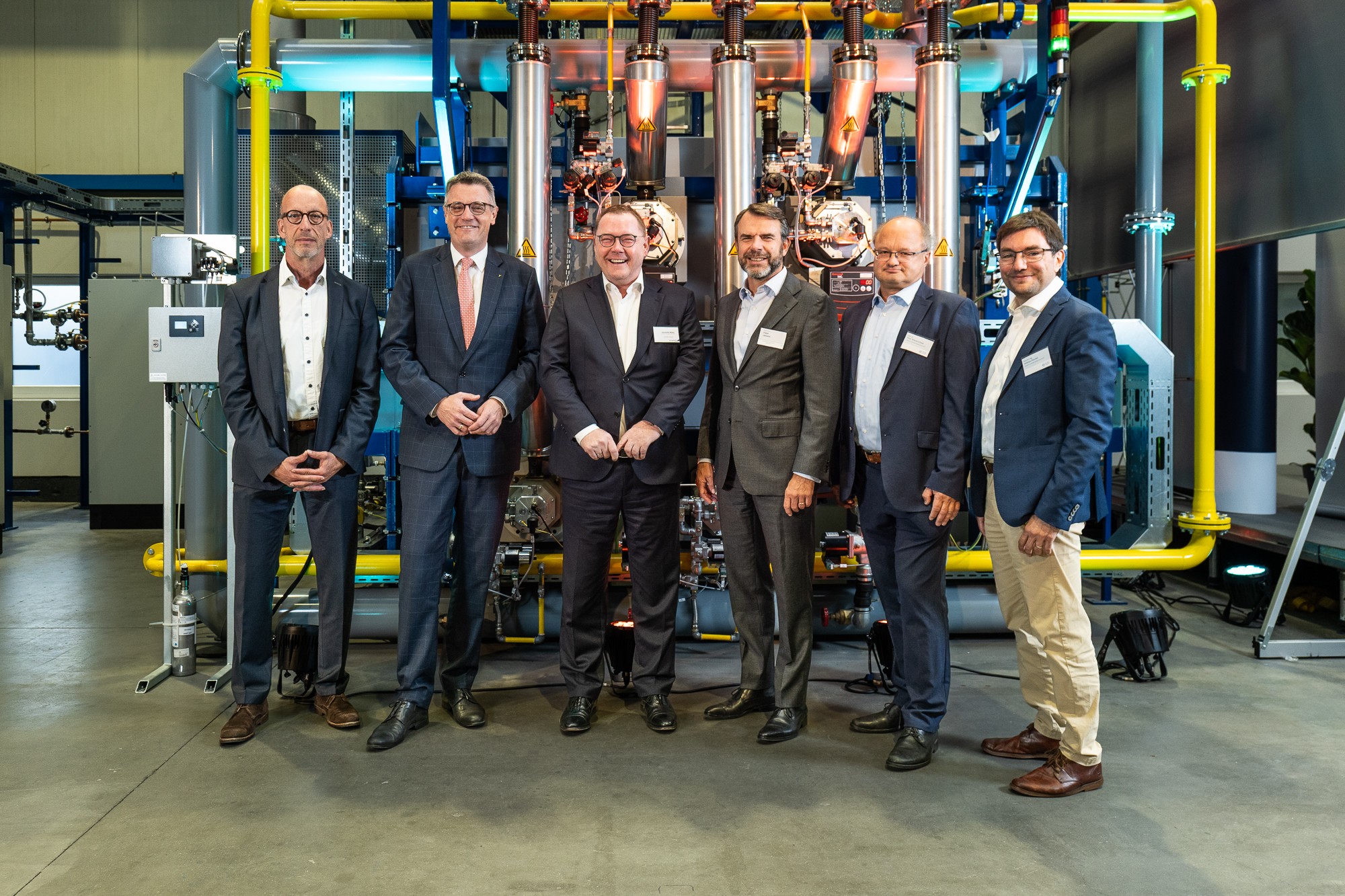

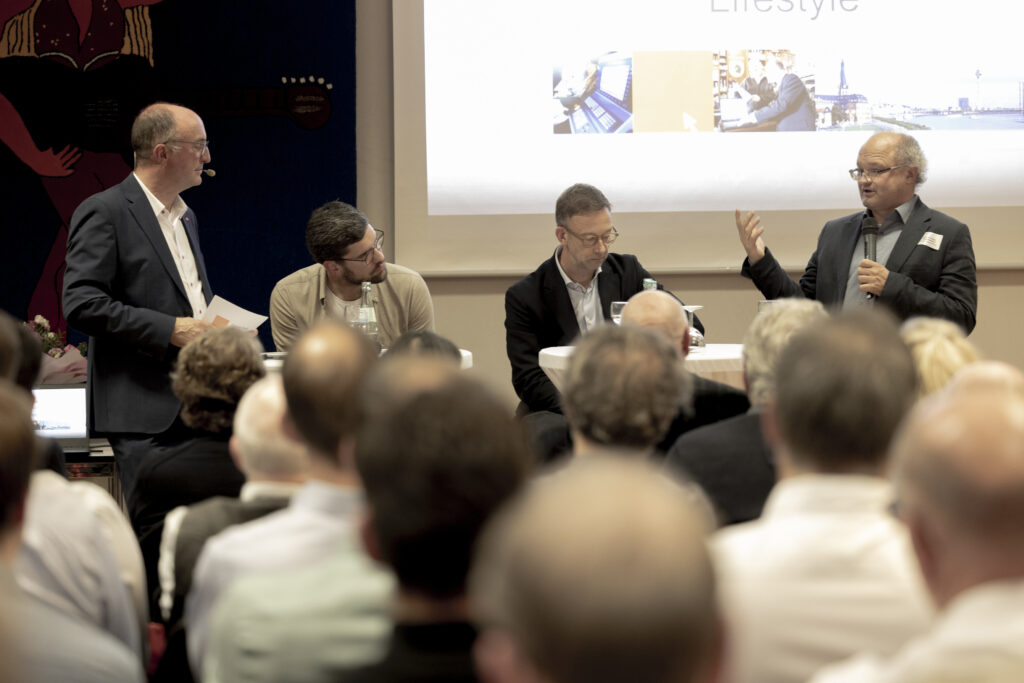
One phrase kept cropping up in various forms on the third day of Hydrogen Day, organised by the Rhine District Neuss/Rhineland Hydrogen Hub. “We just have to do it.” Among others, this was said by Jutta Zülow, hostess of the venue Gut Gnadental in Neuss and founder of the hydrogen hub.
She emphasised this sentence particularly emphatically in her speech and received spontaneous applause for it. Getting started and putting good ideas into practice – that is what needs to happen quickly. The experts who took part in the evening’s discussion panel also agreed on this point.
Prof. Peter Wasserscheid, spokesperson for the Helmholtz Cluster Hydrogen (HC-H2), which is coordinated by Forschungszentrum Jülich, put it this way: “We are making it particularly difficult for ourselves because we want to do it particularly well.” The expert, who is also a member of the hub’s advisory board, was referring primarily to the issue of regulation. This is one of the reasons why the amount of green hydrogen currently produced could be higher. “Hydrogen is only green if the wind farm that supplies the electrolyser with electricity was built solely for this purpose and if the electricity from this wind farm was only generated at the time when it was used to produce green hydrogen,” said Prof. Peter Wasserscheid, addressing the problem of the “green” label. “Green hydrogen could already be half as expensive today if it were enough to feed green electricity into the electrolyser. But instead, we are making everything complicated. This means we will not see any ramp-up.”
“Scale and sell“
The second guest in the discussion, moderated by Hub treasurer Stephan Schneider, approached the topic of regulation from his perspective and came to a very similar conclusion. Lars Redeligx is CEO of Düsseldorf Airport. He also addressed regulations that ensure that flights in Germany are many times more expensive than abroad for climate protection reasons. “This doesn’t save us a single gram of emissions. Because the flights then simply take place abroad.” Instead of regulation, Lars Redeligx advocated innovation, after describing how Düsseldorf is building the largest PV field at an airport in Germany and plans to store some of the energy in hydrogen. This will be used to supply the airport’s infrastructure and heavy goods vehicles on the ground, which will be served by a filling station. “Let’s scale up and sell this technology. We should be part of the solution instead of dwelling on complaints about regulations.” Or, in short: just do it.
Decarbonising process heat
Dr. Simon Hahn, founder of a start-up currently being set up called Clean H2eat and a scientist at Forschungszentrum Jülich. Hydrogen is one of his core topics. But not only. He works with the principle of principle of catalytic combustion, he is working on the major issue of process heat. decarbonisation. 20 per cent of emissions in Germany could have been originate here. He recalled a typical German strength, namely the art of engineering. “We should just do it. The engineer and the inventor can realise that.” His idea: a flexible process heat. Flexible with regard to the temperature level. And in terms of on the energy. “Electricity when it’s cheap. Hydrogen as security in the back. And natural gas for the time being. The decarbonisation of process heat must be economically viable and not just be thought of in idealistic terms.”
“We are privileged here”
When asked about the renewable energy potential of the Rhineland mining region, Prof. Peter Wasserscheid drew a comparison with Bavaria, where he is a member of the board of Zentrum Wasserstoff.Bayern (Hydrogen Centre Bavaria). “I look at Burghausen, where they have been thinking hard for a long time about how to defossilise the Wacker-Werk. Here in the region, there is a lot of wind, and there is the Rhine, which we can use to transport energy stored in hydrogen derivatives. In Burghausen, they would be happy to have such conditions. We are privileged here in terms of conditions.” The region should take advantage of this. True to the motto: just do it. “Because if we wait too long, what happened to me with photovoltaics and other new energy technologies will happen: we invented them. And yet today, 90 per cent of these technologies come from China.”
The copyright for the images used on this website is held by Forschungszentrum Jülich, aligator kommunikation GmbH and
stock.adobe.com.