Hydrogen for industrial process heat: HyHeat demonstrates real-world application
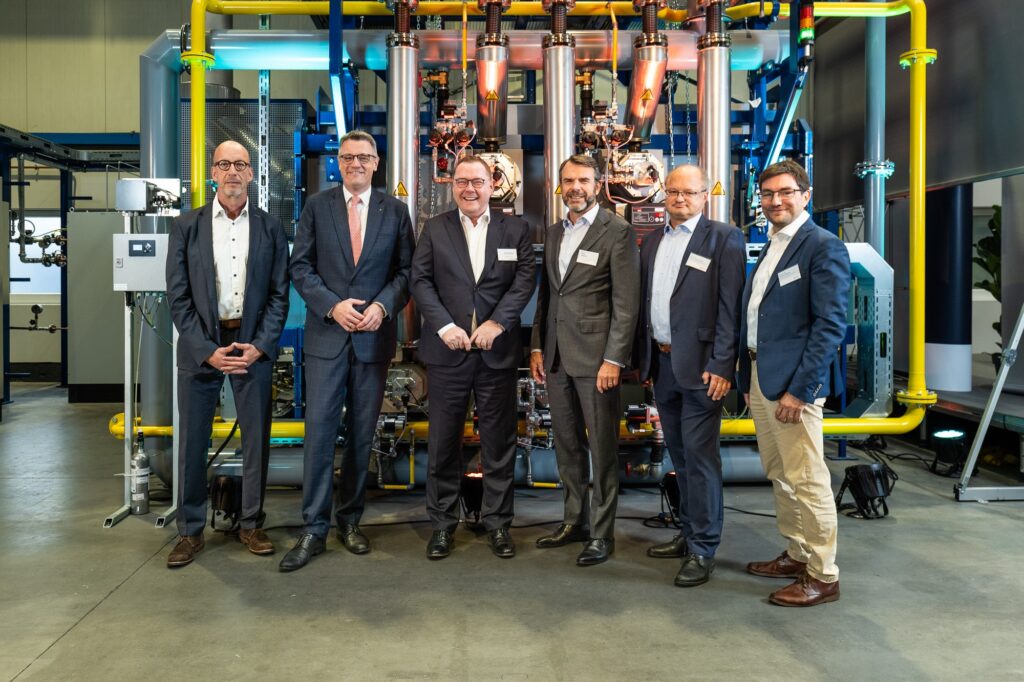
Impressed by the HyHeat demonstration plant in Simmerath (from left): Michael Theben (Head of the Climate Protection Department, Ministry for Economic Affairs, Industry, Climate Action and Energy of the State of North Rhine-Westphalia), Dr. Tim Grüttemeier (Chief Executive (Städteregionsrat) of StädteRegion Aachen“), Alexander Wilden (sole shareholder and Managing Director of the schwartz Group), Prof. Peter Jansens (Member of the Board of Directors of Forschungszentrum Jülich), Prof. Peter Wasserscheid (Director at the Institute for a sustainable Hydrogen Economy, Forschungszentrum Jülich), Prof. Andreas Peschel (Managing Director at the Institute for a sustainable Hydrogen Economy, Forschungszentrum Jülich). Photo: Forschungszentrum Jülich/La Mechky
Specific heat treatment processes are needed to modify the shape and hardness of metals in a targeted way. Among other applications, they play a key role in the press hardening of car body components. In this process, metal blanks are heated to more than 900 °C, which requires a very large amount of energy. The necessary process heat is usually generated by burning fossil fuel gases, resulting in considerable CO₂ emissions.
This is where HyHeat comes in: with the plant, which is already in operation, the schwartz Group and Forschungszentrum Jülich are demonstrating that switching between fossil fuel gas and hydrogen in such high-temperature processes is technically feasible. This marks a significant step towards market readiness.
Reducing CO₂ emissions from process heat
The potential for using hydrogen instead of fossil fuel gases is considerable: a single heat treatment plant for press hardening currently emits around 2,000 tonnes of CO₂ per year. With HyHeat, the partners are showing one way to make this step in automotive production more climate-friendly.
Flexible integration of hydrogen into existing processes
Around 80 per cent of all press-hardened car body components in the automotive sector worldwide are heated in a schwartz Group heat treatment plant. The pilot plant developed in the HyHeat project shows how hydrogen can be flexibly integrated as a fuel gas into existing processes.
“With the pilot plant, we are investigating the switch to hydrogen during ongoing operation. By blending and switching fuel gases without interruption, even small initial quantities of available hydrogen can be put to use,” says Philipp Morsch from the Institute for a sustainable Hydrogen Economy (IHE-4) at Forschungszentrum Jülich, who coordinates the scientific support for HC-H2.
The pilot plant at the headquarters of schwartz GmbH in Simmerath replicates a section of an industrial heat treatment plant. At its technical core are innovative fuel-flexible burners developed by schwartz subsidiary Econova GmbH. In initial tests earlier this year, the pilot plant was already successfully operated with hydrogen. These tests also demonstrated a seamless switchover between different fuel gases. This flexibility is particularly important as long as a widespread hydrogen supply is not yet available everywhere.
Next step: optimising the overall system
The focus is now on the next phase of research: optimising the overall system. The control system is being further developed to achieve the best possible operating conditions regardless of the fuel gas used, whether hydrogen, natural gas or propane.
Scaling up to industrial level brings an additional challenge: industrial heat treatment plants operate with numerous burners that must be carefully coordinated with one another. The pilot plant enables schwartz GmbH’s operations engineers to study these interactions under realistic conditions. The demonstrator thus serves as a testbed to potential industrial-scale heat treatment plants.
Inside the HyHeat pilot plant: the fuel-flexible burners allow operation with different fuel gases and a switch from fossil fuel to hydrogen.
“What matters to our customers is being able to invest in a plant today without having to commit permanently to a single energy carrier. Multi-fuel technology provides the flexibility needed for a gradual transition to hydrogen.”
Alexander Wilden, sole owner and Managing Director of the schwartz Group
“Projects like HyHeat bring the structural transformation in the Rhenish mining area to life and open up future prospects for growth and employment,” says Michael Theben, Head of the Climate Protection Directorate at the Ministry for Economic Affairs, Industry, Climate Action and Energy of the State of North Rhine-Westphalia. “Concrete projects like this one, carried out in partnership with local companies, are of great value to the region. We hope to see more projects of this kind soon.”
Copyright: MWIKE
“Projects like HyHeat bring the structural transformation in the Rhenish mining area to life and open up future prospects for growth and employment. Concrete projects like this one, carried out in partnership with local companies, are of great value to the region. We hope to see more projects of this kind soon.”
MWIKE/NRW: Michael Theben, Head of the Climate Protection Directorate
Using waste heat for hydrogen supply
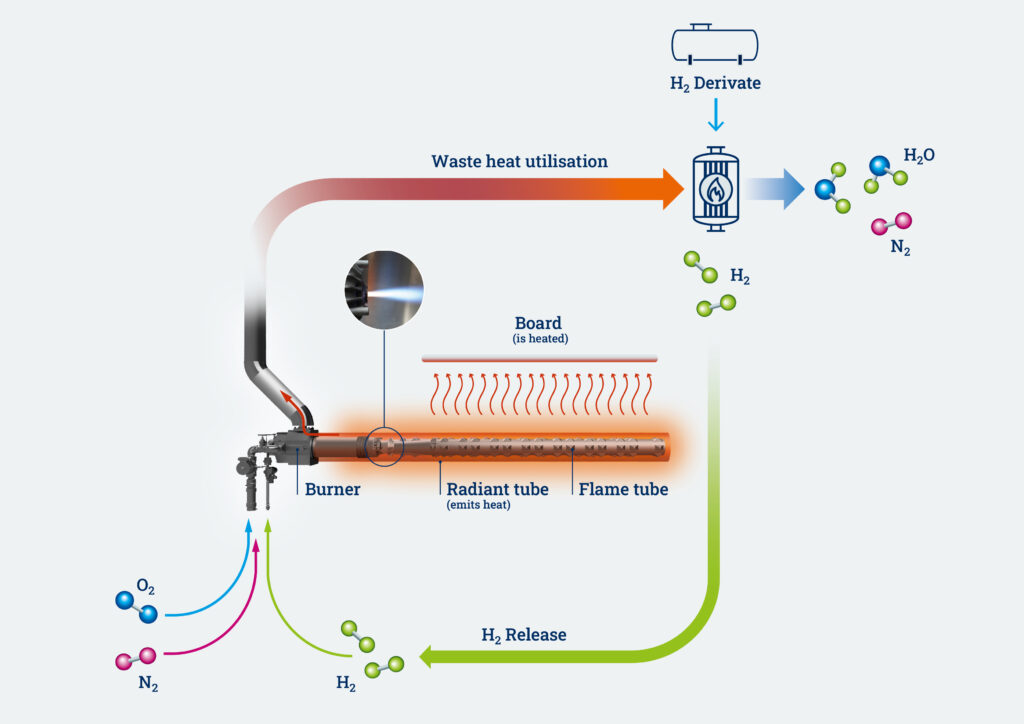
In addition to burner operation at the pilot plant, Forschungszentrum Jülich is using HyHeat to investigate how industrial sites without a hydrogen pipeline could be supplied in future. The focus here is on chemical hydrogen storage. Using simulations, researchers at Forschungszentrum Jülich’s Institute for a Sustainable Hydrogen Economy (IHE) are examining which storage technology is best suited for use in industrial heat treatment plants. Heat integration plays a key role here. In accompanying studies, IHE is investigating whether the heat contained in the exhaust gas could be used in future to release the chemically bound hydrogen from the storage medium.
The HyHeat concept: in future, waste heat from heat treatment is intended to help release chemically bound hydrogen at the industrial site and make it available for burner operation. Graphic: Forschungszentrum Jülich
About the Helmholtz Cluster for Hydrogen
The Helmholtz Cluster for Sustainable and Infrastructure-Compatible Hydrogen Economy (HC-H2) supports the structural transformation in the Rhenish mining area through research and demonstration projects centred on a sustainable hydrogen economy. At the heart of the cluster is Forschungszentrum Jülich’s Institute for a Sustainable Hydrogen Economy (IHE). HC-H2 is funded by the Federal Ministry of Research, Technology and Space and the State of North Rhine-Westphalia until 2038.
“Burner technology for hydrogen is already well researched. The task in the HyHeat project is to turn a single burner into a complete heating concept. Process stability and compliance with safety standards are key cornerstones. This is the only way fuel-flexible technology can be deployed on an industrial scale.”
Dr. Horst Graf von Schweinitz, Managing Director, econova GmbH
Copyright: Forschungszentrum Jülich
“HC-H2 is deliberately designed so that research and application learn from each other. The experience gained from HyHeat feeds directly back into our work at IHE and shapes the questions we tackle next.”
Prof. Dr. Peter Wasserscheid, Spokesperson of HC-H2
Copyright: Forschungszentrum Jülich
“Innovation happens where scientific expertise meets industrial know-how. In HyHeat, each side contributes what the other lacks, and that is exactly what creates a solution neither could have developed alone.”
Prof. Dr. Peter Jansens, Member of the Board of Directors, Scientific Division II
Copyright: Forschungszentrum Jülich
“With HyHeat, we are demonstrating one way in which an energy-intensive metalworking process can be made climate-friendly, with greater planning certainty and competitive in the future.”
Philipp Morsch, Project Lead HyHeat, Forschungszentrum Jülich
The copyright for the images used on this website is held by Forschungszentrum Jülich, aligator kommunikation GmbH and stock.adobe.com.
Current
The Green Backbone of the Energy Transition
August 6, 2026
Hydrogen is a colourless gas. So why do people talk about the colours of hydrogen? The colours refer to how it is produced – and
Firmly anchored to the ground, the structure of the Brainergy Hubs is steadily taking shape. For now, the building’s distinctive circular design is only beginning
Peter Wasserscheid to Coordinate European Hydrogen Programme
June 25, 2026
Professor Peter Wasserscheid of Forschungszentrum Jülich has been appointed Coordinator of the Clean Hydrogen Joint Programme of the European Energy Research Alliance (EERA). The programme
The future is green: container power plant arrives at Erkelenz hospital
June 11, 2026
A heavy-duty crane has lifted Reverion’s fuel-cell power plant into place at Hermann-Josef Hospital in Erkelenz. With the installation of the striking green container, the
Hydrogen pathways for regions beyond the core network
June 8, 2026
Scientists at Forschungszentrum Jülich have outlined new approaches for supplying hydrogen to areas that will not be connected to Germany’s planned hydrogen core network by
How is hydrogen produced? How is hydrogen produced? What role could it play in building a climate-friendly energy system for the future? And what exactly
They are invisible yet indispensable: membranes save lives and play a crucial role in the production of hydrogen. Research is constantly striving to improve them.
A bacterium discovered by a research team from the University of California in the mid-1980s in the Gulf of Naples has a remarkable property. “Thermogata
Our name is a challenge: Helmholtz Cluster for a Sustainable and Infrastructure-Compatible Hydrogen Economy. Anyone who presents it needs a short break afterwards due to
Climate-friendly pathways for industrial sand drying
April 24, 2026
Forschungszentrum Jülich and Nivelsteiner Sandwerke und Sandsteinbrüche GmbH (Herzogenrath) are collaborating in the HySand demonstration project to develop climate-friendly, cost-efficient solutions for industrial sand drying.