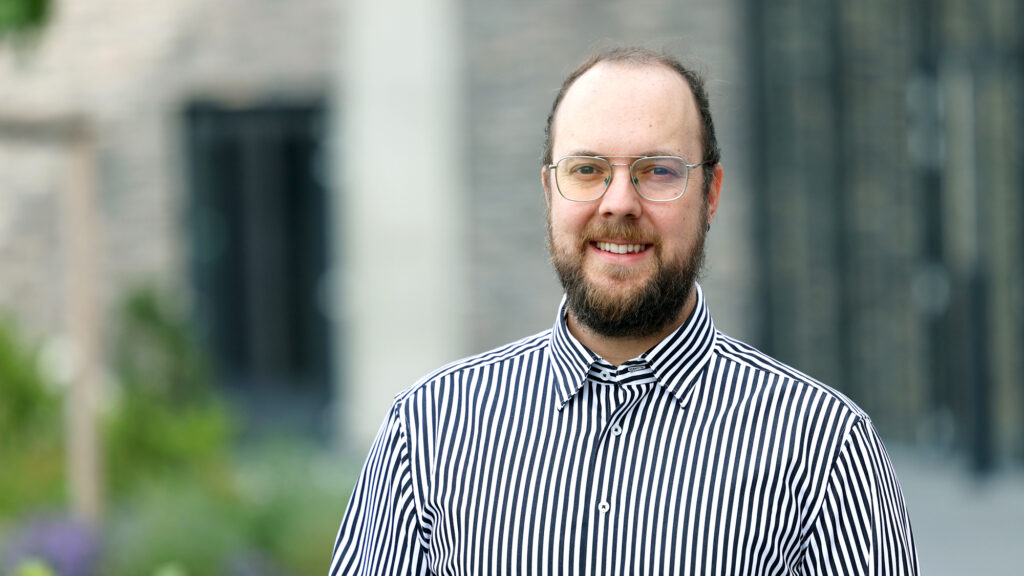
Understanding chemical reactions and using that knowledge to develop processes for sustainable energy carriers: this combination of fundamental research and practical application has earned Dr Patrick Schühle the 2026 Carl Zerbe Prize. He heads the Reaction Kinetics Department at the Institute for a sustainable Hydrogen Economy (IHE) at Forschungszentrum Jülich.
The German Scientific Society for Sustainable Energy Sources, Mobility and Carbon Cycles (DGMK) is recognising his research in catalysis and chemical reaction engineering. The prize carries an award of €5,000.
“I would like to thank the DGMK for this award and for recognising our research. We aim to understand the fundamentals of catalytic reactions and use that knowledge to develop practical processes for a sustainable carbon and hydrogen economy,” says Patrick Schühle.
Connecting fundamental research with practical applications
In his laudatory address, Tilman Bechthold, Chair of the DGMK’s Division for Conversion of Carbon Carriers, highlighted Patrick Schühle’s targeted combination of fundamental catalysis research with reactor and process engineering geared towards practical applications. Together with DGMK Managing Director Gesa Netzeband, he presented the award in Essen at the close of the first day of the autumn conference “Processes for a Resilient Supply of Carbon Carriers, Fuels, and Chemicals”. The DGMK organised the conference jointly with the Austrian Society for Energy Sciences (ÖGEW) and the Division of Industrial Chemistry of the Italian Chemical Society (Società Chimica Italiana, SCI).
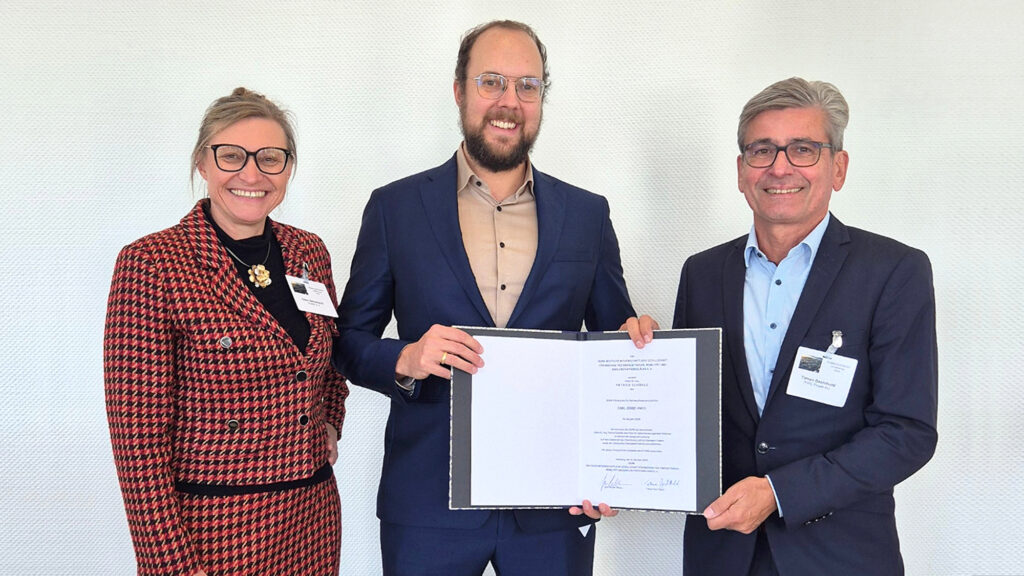
Alongside his leadership role at IHE, Patrick Schühle has led a research group on catalytic systems for chemical energy storage at the Chair of Chemical Reaction Engineering at Friedrich-Alexander-Universität Erlangen-Nürnberg (FAU) since 2021. Since 2024, he has also headed a junior research group there, funded by Germany’s Federal Research Ministry. The group is developing a process to produce hydrogen from biomass via formic acid as an intermediate.
Professor Peter Wasserscheid has played an important role in his career at both institutions. The IHE Director and holder of FAU’s Chair of Chemical Reaction Engineering received the Carl Zerbe Prize in 2000.
In his acceptance speech, Patrick Schühle called for a rapid transition to sustainable energy carriers and production processes. One approach, he said, was a circular economy incorporating new chemicals and energy carriers. “Global warming is already a reality. That is why we must not delay the transformation of the carbon economy,” says Patrick Schühle.
The DGMK awards the Carl Zerbe Prize for outstanding work by early-career researchers on the processing and application of carbon carriers. It established the prize in 1973. The award is named after the chemist Carl Zerbe, who was a founding member of the society in 1947.
The copyright for the images used on this website is held by Forschungszentrum Jülich, aligator kommunikation GmbH and stock.adobe.com.