Hydrogen was long considered the magic word of the energy transition – but is now increasingly viewed with scepticism. For Prof. Peter Jansens, member of the Board of Forschungszentrum Jülich, hydrogen remains indispensable: not as a cure-all, but as a supporting pillar of a sustainable energy economy. In this interview, he speaks about new ways of thinking in research, the strengths of our region, European alliances, and why hydrogen is a sustainable bridging technology.
A few years ago, it felt as though every answer to an energy-related question was “hydrogen”. Today, hydrogen is often viewed critically. What is your position?
Peter Jansens: We need to move away from the idea of a standalone hydrogen economy. Too much has been said about it, and that may have raised expectations too high. The real goal is a sustainable energy economy in which hydrogen is one of the supporting pillars. What matters is not how much hydrogen costs as part of the solution, but how expensive the final products – steel, cement, cars or electricity – will be. Individual parts of the value chain may become more expensive, but the overall chain often remains of higher quality or even cheaper – and therefore competitive.
Which innovation in energy technology do you consider particularly important?
Peter Jansens: I don’t want to answer with a single innovation, but with a new way of thinking. What inspires me here in Jülich is a changed self-image. We see ourselves as contributing to solutions for societal challenges. When I studied and completed my doctorate, our generation wanted to make everything more efficient through strong fundamental research. Don’t get me wrong: that is still crucial today. But today, we conduct research on fundamental scientific questions as well as on answers to societal challenges. The Helmholtz-Cluster for a Sustainable and Infrastructure-Compatible Hydrogen Economy (HC-H2) does both. The cluster was one of the reasons I applied to Jülich.
In what way?
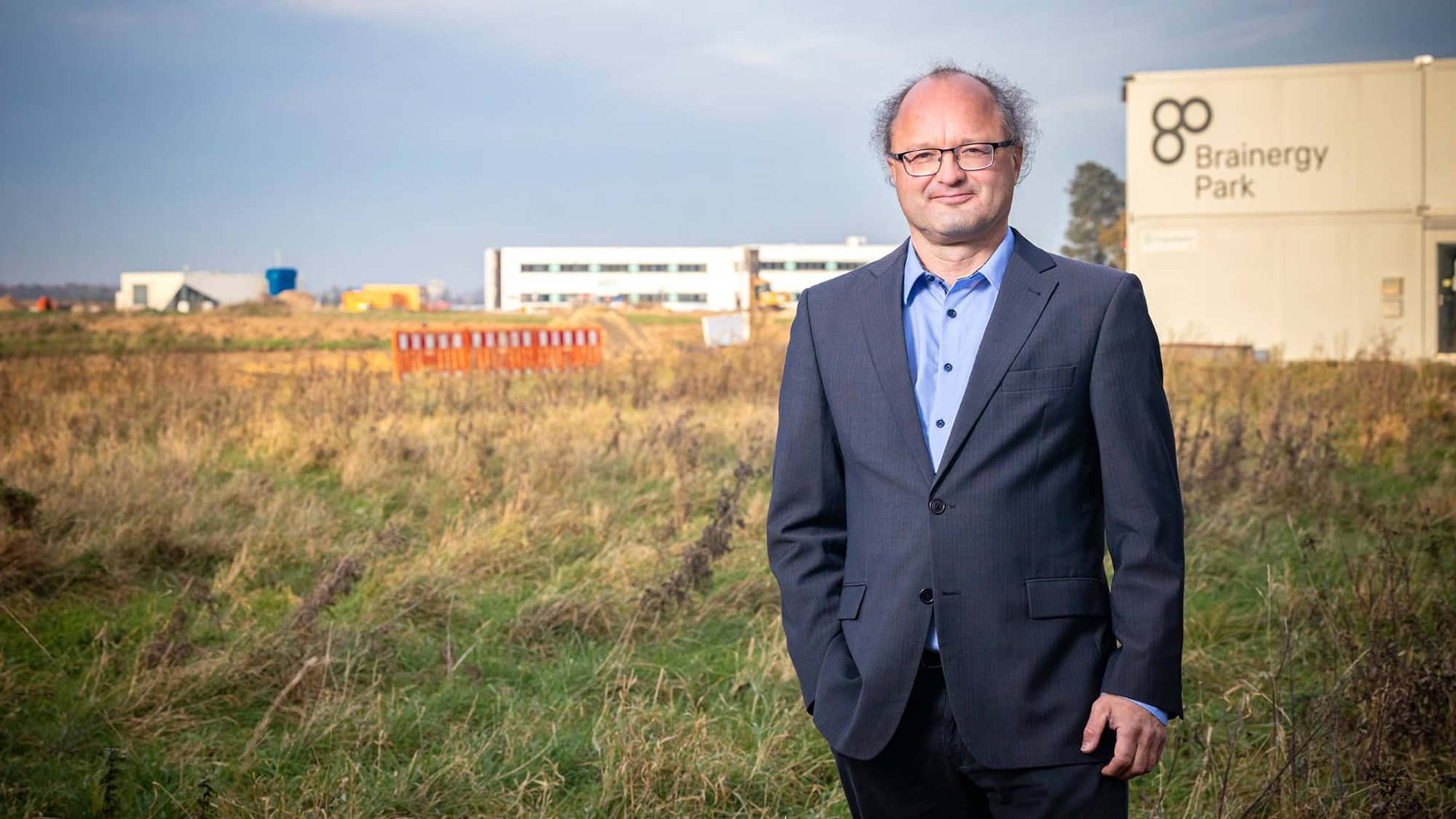
Peter Jansens: I remember a day four years ago when I visited the Brainergy Park – the place where the Institute for Sustainable Hydrogen Economy was to be established. That was before I started at Forschungszentrum Jülich. At that time, there was only a single container in the park, and I met six enthusiastic pioneers there. Today, structural transformation is becoming tangible because local solutions to global challenges are emerging. This approach motivates me enormously – it is as important as scientific excellence. Hydrogen is indispensable for this. Here on site, with innovative hydrogen technologies that we demonstrate in application, we can make a direct contribution.
Are we too critical of our own capabilities?
Peter Jansens: Germany is extremely strong in developing complex technologies such as electrolysers, photovoltaics and battery storage. Companies like Bosch, Siemens and Neuman & Esser are world leaders. Hydrogen technologies never consist of just one component; they are part of a complex system. They are one of several pillars of our future energy system. Making this complexity usable – that is where Germany excels.
Nevertheless, supposed experts often criticise hydrogen as inefficient, expensive, and of little use.
Peter Jansens: If we continue to expand renewable energies, hydrogen and its derivatives will remain indispensable. Methanol and ammonia are two such derivatives – molecules based on hydrogen. They are established, whether as industrial feedstocks, energy storage media or transport molecules. Substances such as methyl tert-butyl ether or liquid organic hydrogen carriers, so-called LOHCs (large carrier molecules that can store hydrogen and release it again later), have potential for storing and transporting energy. Hydrogen will not dominate everywhere, but it will certainly be very important in Germany. Western Germany, for example, has always consumed more energy than it produces. At the same time, it is technologically strong. That is why we need energy imports to meet our needs. Hydrogen carriers can play an important role here. Spain or France can produce more energy domestically, while Germany can develop solutions for storage and transport. Therefore, we need European solutions: Germany needs Europe for imports, Europe needs Germany for technologies.
This year, the research centre announced that the Jülich campus had already met the CO₂ reduction targets originally set for 2030. How does this contribute to society?
Peter Jansens: It is easier for us to demonstrate new technologies. We are investing heavily and are ahead of schedule. We are rightly proud of that. But we do not only demonstrate things that work for us. Concepts such as heat integration are transferable – for example, using waste heat from the JUPITER supercomputer for other applications. There are many large-scale industrial processes whose waste heat can be used according to the principles we demonstrate. We are developing and demonstrating intelligent energy control for buildings. That is what our Living Lab Energy Campus is for: a real-world laboratory in which we show how future energy supply systems can be integrated into other processes.
Another communication from Jülich stated that golf courses occupy more land area than photovoltaic installations. What can we conclude from this?
Peter Jansens: Our system analysis experts illustrate the consequences of decisions. The result is not directed against golf courses but makes something clear: energy becomes more expensive if we do not want wind turbines or photovoltaics within sight. The less we generate ourselves, the more we must import. That increases our economic and geopolitical dependence – especially on countries that export fossil energy. We also cannot expect Spain to build photovoltaic installations everywhere on our behalf simply because we do not want them here. The analyses show very clearly which compromises are necessary. Fewer installations here mean higher energy costs. That is why I am convinced that a European system in which countries contribute their strengths is more stable, more independent, and more affordable.
What headlines would you like to read in the future?
Peter Jansens: For example, that we have built more demonstrators in the Rhenish mining area – like at the Erkelenz hospital, where we demonstrate how a large energy consumer can be supplied with hydrogen. I would like to see headlines about solutions for farms or industrial companies, and for major transport systems such as ships, trains, and lorries. And that our results contribute to the acceptance of new technologies.
More broadly speaking, as a Dutchman, what is your view of Germany?
Peter Jansens: Germany has always been strong in science and technology. It is progressing well in the energy transition because it has a great deal of knowledge and approaches it with determination and courage. It must do so, because Germany has never been able to meet its own energy demand alone and has always needed good solutions for storing and transporting energy. Politics and society understand the importance of new technologies. That is why I enjoy working here.

“This structural change also requires a cultural change.”
Prof. Peter Jansens, Member of the Board of Directors of Forschungszentrum Jülich
Why is Germany struggling despite having so many good solutions?
Peter Jansens: Germany has recognised very well that a structural transformation of its energy system is necessary and is implementing it with courage. But this structural transformation also requires a cultural transformation – and that is more difficult for Germany. It is about increasing agility and reducing bureaucracy. Germany should focus more on outcomes instead of discussing the process. It should be more important to reward success than to point out mistakes. And it is important to recognise that we will not achieve our goals if we keep riding the same horse until it collapses. We need to reward the willingness to find the best horse for each task.
You spoke about Germany’s need for imports. Critics describe plans to import hydrogen from Africa as a new form of colonialism.
Peter Jansens: Those who make such accusations do not know our programmes. The Hydrogen Atlas Africa trains young people locally through a master’s programme. This enables countries to build their own hydrogen economy with their own experts and to become equal partners. The Atlas considers political, social, environmental and economic aspects. That is how we ensure that we do not recreate colonial structures.
Hydrogen is often associated with various metaphors. It is called the “champagne of the energy transition” – rare and expensive. Or it is compared to a Swiss Army knife: capable of everything but rarely used because people prefer specialised tools. Which comparison fits best in your view?
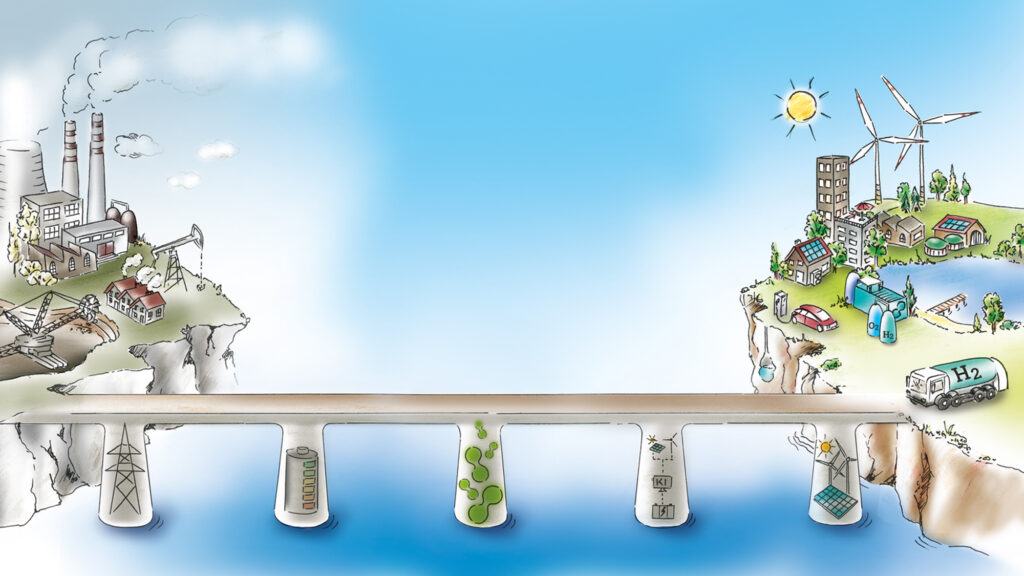
Peter Jansens: Hydrogen is, for me, an essential pillar of the bridge that takes us from a fossil energy system towards a green, sustainable and affordable one. This bridge has several pillars: battery storage, the electricity grid, intelligent control, renewable energies – and hydrogen. We need all of them. They pave the way towards net-zero greenhouse gas emissions. Hydrogen is therefore a bridging technology, but not in the sense of a temporary stopgap. Hydrogen will play a key role for a long time to come.
About the person
Peter Jansens (57) has been a member of the Board of Forschungszentrum Jülich since January 2023 and is responsible for the areas conducting research for the energy transition. The chemical engineer studied and completed his doctorate in Delft, worked for Shell in Amsterdam and Singapore, and later served as Professor of Separation Technology at TU Delft. From 2008 onwards he held senior positions at the chemical company DSM, most recently as CEO of the joint venture Olatein. In 2005 he became the first foreign scientist to receive the prize of the German Society for Chemical Engineering and Biotechnology (DECHEMA) for his work on crystallisation.
The copyright for the images used on this website is held by Forschungszentrum Jülich, aligator kommunikation GmbH and stock.adobe.com.