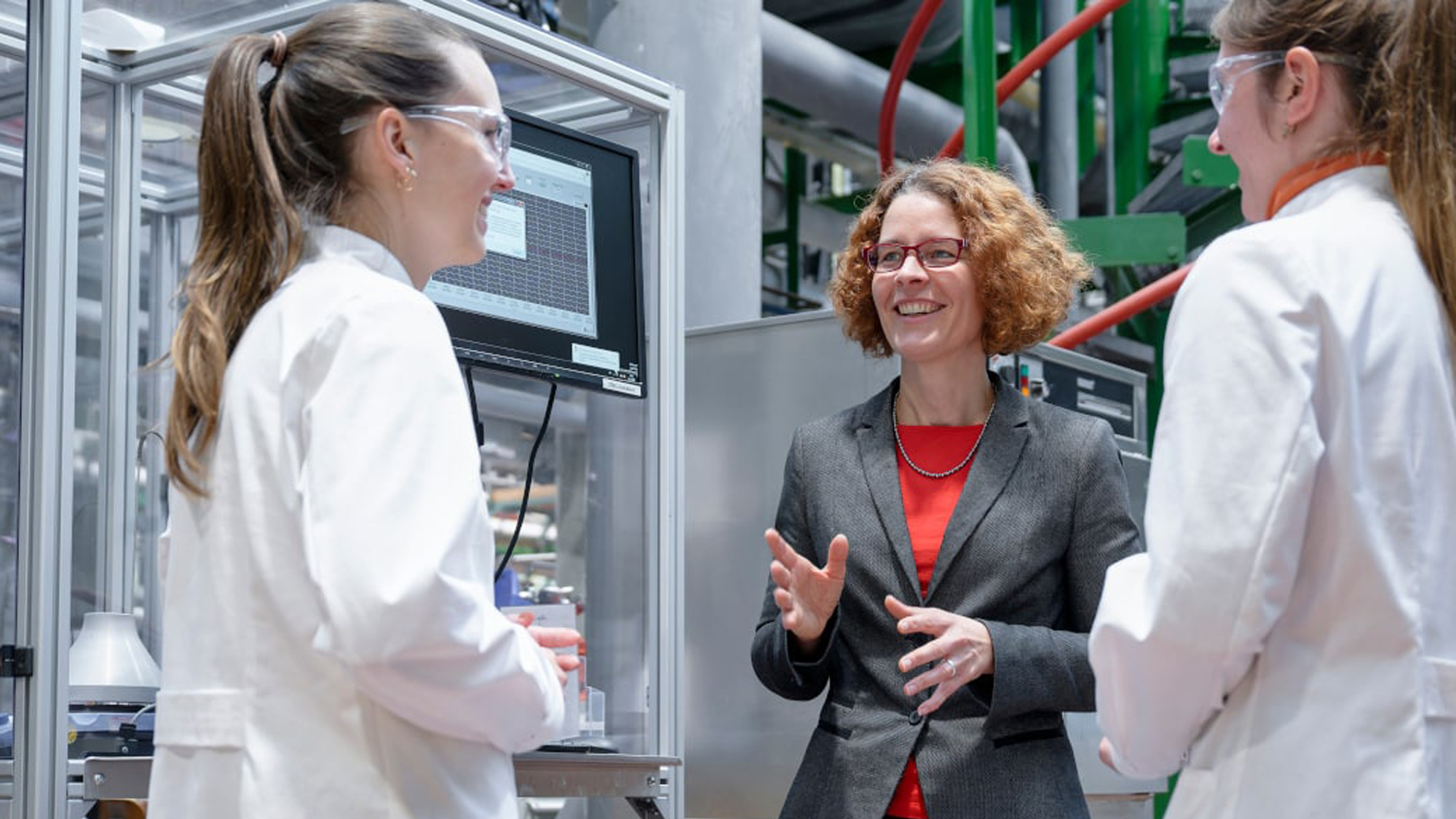

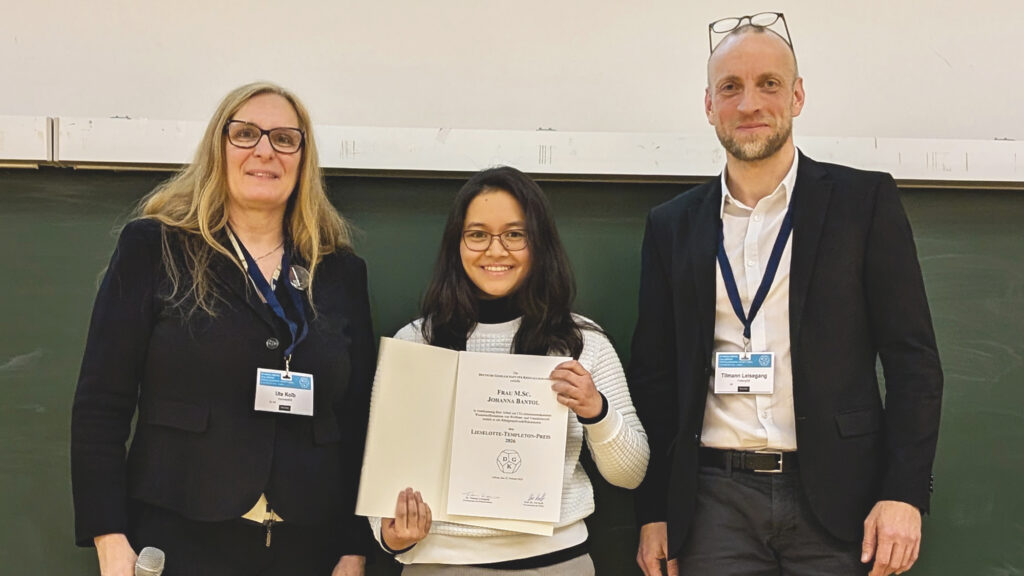
Researcher Johanna Bantol from Forschungszentrum Jülich has received the Lieselotte Templeton Prize of the Deutschen Gesellschaft für Kristallographie (German Crystallographic Society, DGK). The award was presented to the doctoral researcher from the Institute for a sustainable Hydrogen Economy (IHE) at Forschungszentrum Jülich during the 34th DGK Annual Meeting (25-28 February) in Lübeck. Each year, the DGK honors outstanding Bachelor’s and Master’s theses that successfully apply the methods and conceptual approaches of crystallography.
Crystallography is the science that determines and describes the three-dimensional arrangement of atoms in crystalline materials. Researchers expose crystals to X-rays, analyze the resulting diffraction patterns, and reconstruct exactly where each atom is located within the material—the atomic blueprint of a solid.

Johanna Bantol
An international study program
“I feel very honored to receive this recognition in Germany as a young researcher from the Philippines,” said Johanna Bantol. She completed the international Erasmus Mundus master’s program “Advanced Spectroscopy in Chemistry” in Lille (France), Bologna (Italy), and Leipzig (Germany). At Leipzig University, she carried out her master’s thesis at the Institute of Inorganic Chemistry and Crystallography under the supervision of Prof. Holger Kohlmann. Since autumn 2025, she has been pursuing her doctorate at IHE-1 in Jülich. The institute section is headed by Prof. Hans-Georg Steinrück. The researchers use X-rays to understand and optimize catalysts for hydrogen technologies at the atomic scale.
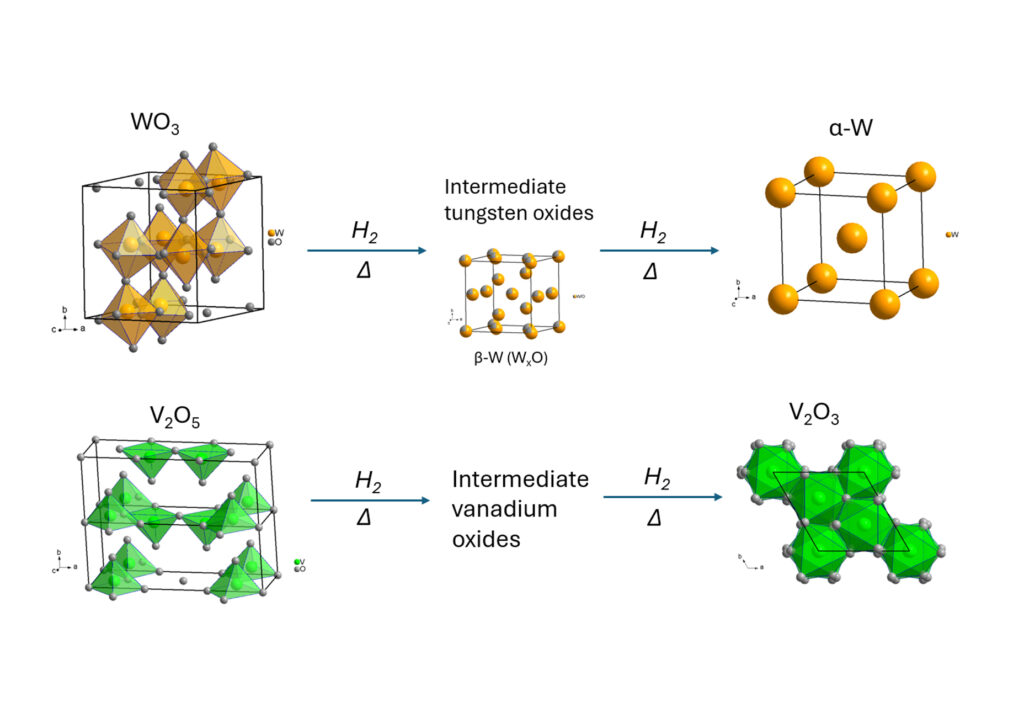
In her master’s thesis, Johanna Bantol investigated how intermediate phases formed during the production of the metals vanadium and tungsten can be selectively stabilized – for example by varying parameters such as hydrogen flow rate and temperature. The focus is on direct reduction with hydrogen, a chemical reaction in which hydrogen acts as a reducing agent by stepwise removing oxygen from a metal oxide – that is, a compound of metal and oxygen –until the pure metal remains.
The choice of reducing agent has a major impact on the carbon footprint. When hydrogen removes oxygen from the metal oxide, water is formed as the reaction product. By contrast, if carbon is used – for example in the form of coke or carbon monoxide (CO) – the oxygen typically ends up as carbon dioxide (CO₂), a greenhouse gas.
Revealing the “fingerprint” of materials
Johanna Bantol tracked the formation of vanadium and tungsten intermediate phases during hydrogen-based direct reduction using in situ X-ray powder diffraction. In simple terms, this method records the structural “fingerprint” of crystalline phases during an ongoing reaction. The samples are analyzed in powder form, consisting of very small crystals. This allowed Johanna Bantol to determine step by step under which conditions specific intermediate phases form, how long they remain stable, and how they can be selectively targeted.
For tungsten, she showed that a higher hydrogen flow rate causes a potentially interesting intermediate phase to form earlier and remain stable for longer. In the case of vanadium, two intermediate phases become stable under specific temperature conditions and can therefore be used in a targeted way.
Intermediate phases with high application potential
These intermediate phases are more than just steppingstones. In the case of vanadium, they are considered key materials for new energy storage systems, smart materials, and future computing technologies. In addition, vanadium is widely used to make steel harder, tougher, and more resistant. Tungsten is extremely hard, heat-resistant, and dense, and is commonly used in hard metals, cutting tools, wires, and electrodes. Tungsten-containing oxides are also of interest for exhaust gas catalysts and sensors.
“Johanna’s findings are particularly significant because they provide insights into the underlying reaction mechanisms. This is crucial for the targeted use of these materials, for example in batteries or quantum materials,” said Hans-Georg Steinrück.
The copyright for the images used on this website is held by Forschungszentrum Jülich, aligator kommunikation GmbH and stock.adobe.com.