Demonstration project
Multi-SOFC
Climate-friendly energy supply at the hospital in Erkelenz
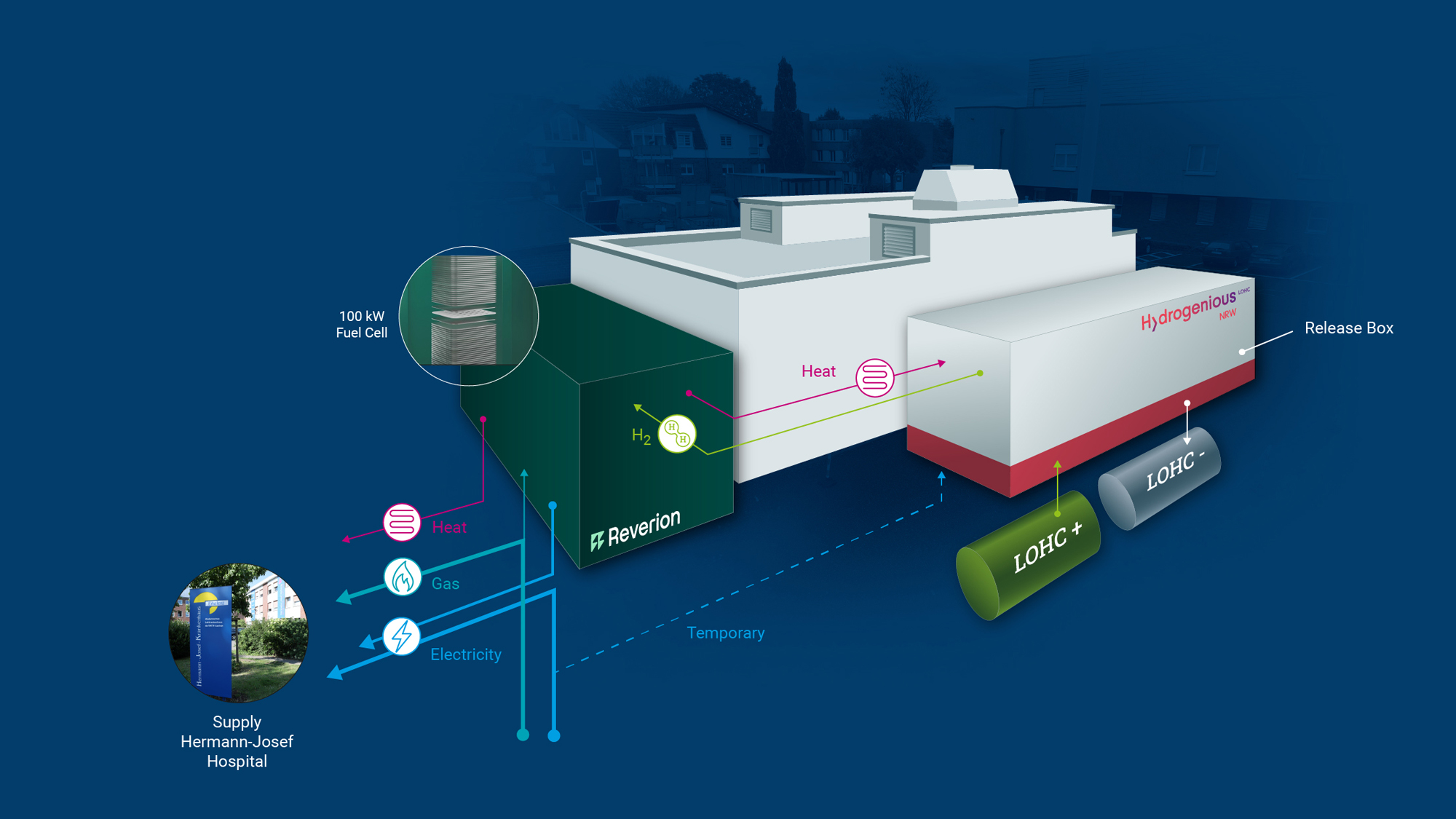
A more climate-friendly energy supply is the goal that the partners want to demonstrate by the end of the project. This will create a flagship project in Erkelenz that can develop far-reaching appeal. Reverion GmbH and Hydrogenious LOHC NRW GmbH are demonstrating the coupling of new hydrogen technologies on an economically relevant scale at the Herman-Josef Hospital. The aim is to make the hospital’s energy supply more climate-friendly and cost-effective. The Federal Ministry of Research, Technology and Space (BMFTR) is funding the project with 23.6 million euros.
Reverion GmbH, Hydrogenious LOHC NRW GmbH, Hermann-Josef Hospital in Erkelenz, and the Helmholtz Hydrogen Cluster want to demonstrate that the new combination of the two hydrogen technologies can cover 20 percent of the Erkelenz hospital’s electricity and heating requirements. This is a relevant scale that enables the technology to be scaled up for larger requirements and other applications.
Management of the project

“We are convinced that the technologies shown in our Multi-SOFC demonstration project can attract a great deal of interest. We are continuously optimising the new system during the project and will have a data set at the end that the project partners can use as a basis for scaling up the combined system for industrial applications.”
Dr. Michael Alders, senior project engineer at HC-H2. Photo: ©Forschungszentrum Jülich/Limbach
What happens here, technical details
The first phase of the project with the commissioning of the SOFC units has been successfully completed. The SOFC system has initially been supplied with natural gas. The project partners have shown a significantly improved carbon footprint compared to the conventional power supply of the HJK with a combined heat and power plant. This is because the fuel cell system saves up to 40 per cent of CO2 emissions when running on natural gas. The reason for this is the higher electrical efficiency. In natural gas operation, the Bosch fuel cell system generates an electrical efficiency of up to 60 per cent. In comparison, the combined heat and power plant only achieves around 36 per cent.
Afterwards, the project partners began blending hydrogen into the natural gas, gradually increasing its share step by step. The hydrogen is initially supplied in pressurized gas cylinders. As the hydrogen share increased, CO₂ emissions at HJK continued to decline. Over time, the proportion of hydrogen in the gas mixture rises to as much as 20 percent. This provides insights for a possible future development toward an energy supply based entirely on hydrogen.
The Reverion M-100/250 container power plant supplies the hospital with electricity and heat from hydrogen or natural gas, with an electrical output of 100 kW. It achieves an electrical efficiency of up to 80 percent. This allows the hospital to save 128 tonnes of CO₂ emissions per year from electricity generation alone. Because the power plant can operate reversibly, the hospital can not only convert hydrogen into energy, but could also produce hydrogen itself and thus store surplus photovoltaic electricity.
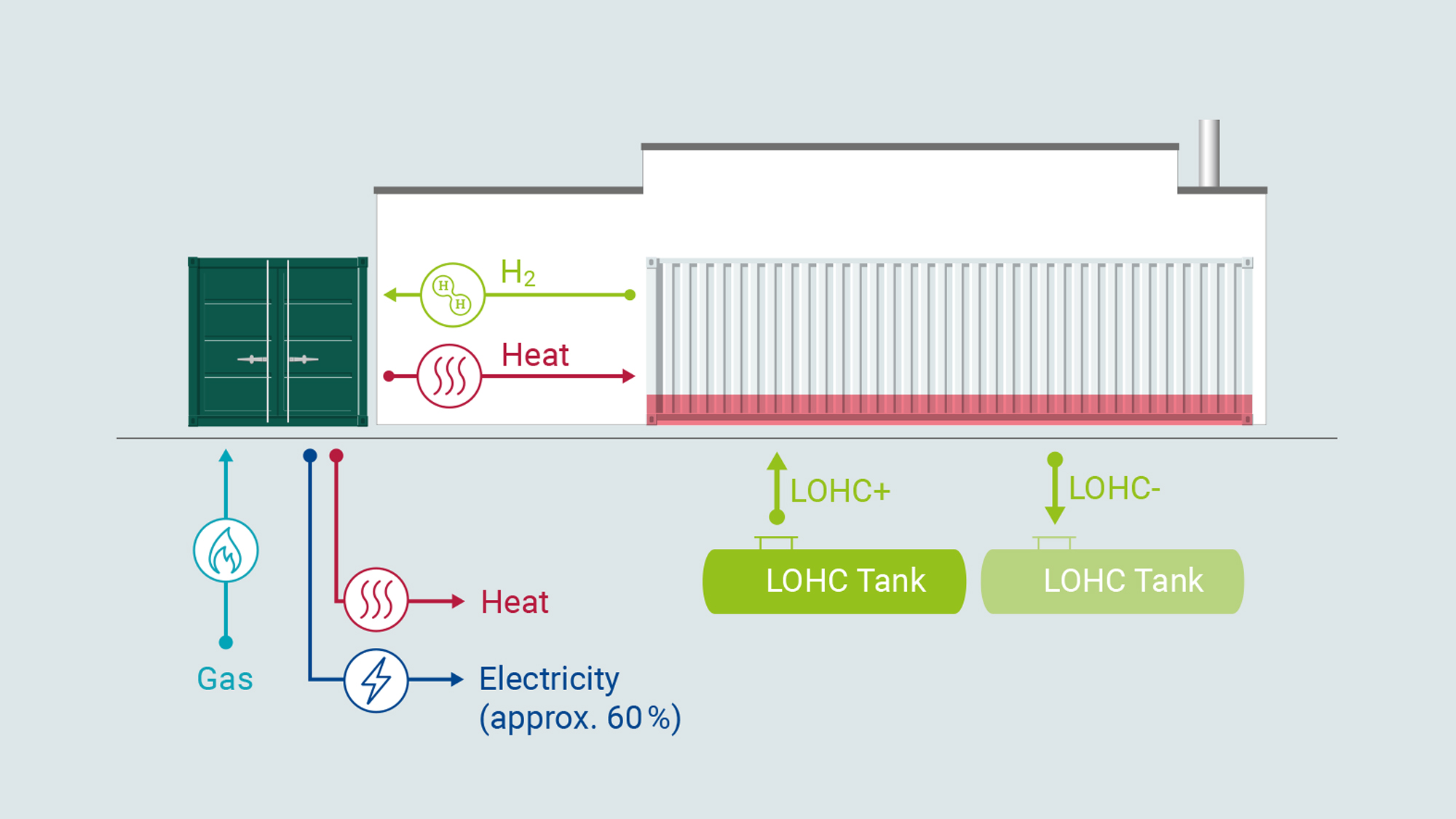
The energy centre is being rebuilt with an SOFC system (left) and LOHC technology.
Graphic: Research Centre Jülich/Reisen
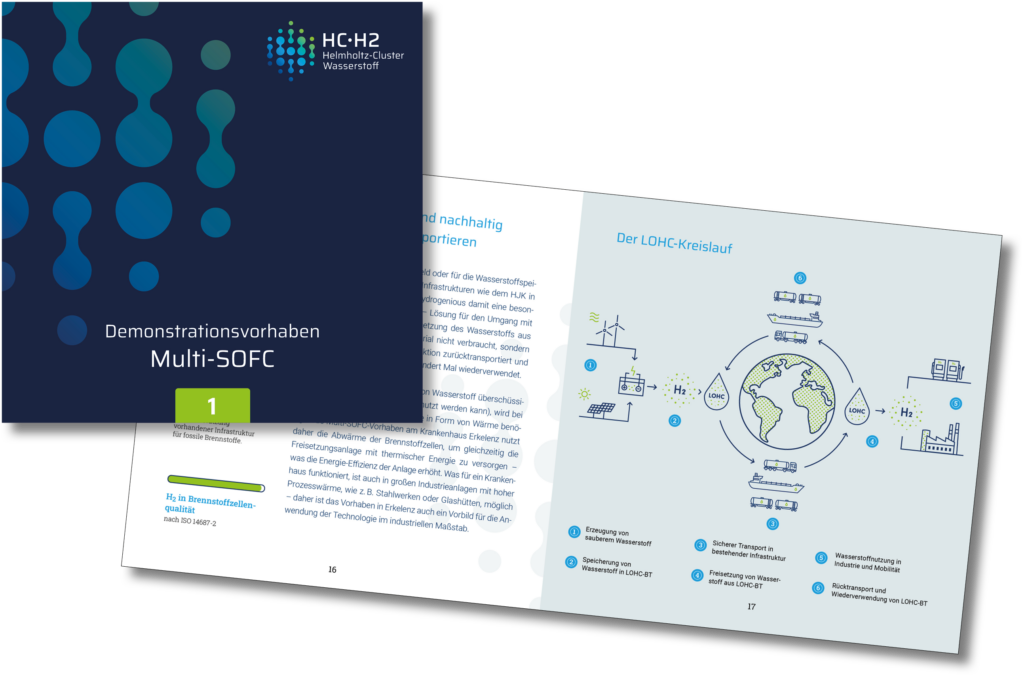
In the next step, LOHC technology will replace gas cylinders. Until then, Hydrogenious LOHC NRW GmbH has installed its infrastructure at the HJK. This enables hydrogen to be delivered to Erkelenz in a conventional tanker lorry under ambient conditions. In order to release the hydrogen from the LOHC, energy in the form of heat must be supplied to the thermal oil. The partners want to show that it is possible to utilise the waste heat generated by the SOFC system when converting the gas mixture into electricity.
Once the hydrogen has been released, the discharged carrier material flows into a second underground tank. It can then be transported back to a hydrogen generator and recharged with hydrogen – similar to the returnable bottle principle.
The newly installed technology does not replace the hospital’s tried and tested supply. The HJK continues to use a combined heat and power unit and a gas engine as a fall-back option, which can also supply the building alone if required.
Anyone interested in finding out more about the Multi-SOFC project can send an email to info.hch2@fz-juelich.de.
Animated Film
Brochure
Our partners



Project status
128
Tonnes of CO2 saved
per year, solely through electricity generation
1
Reverion M-100/250
Number of Power Stations installed
80 %
Electrical effiency
18 kW
Thermal output